Ich was ein chint so wolgetan
Wednesday, July 9th, 2008 11:21 am![[personal profile]](https://www.dreamwidth.org/img/silk/identity/user.png) mothwing
mothwingIch was ein chint so wolgetan from the Carmina Burana (carmina amatoria, no. 185) is one of my favourite songs, even though it's basically about rape (the story is basically this: a young country girl, picking flowers, meets a man who lures her back to some linden trees and has sex with her against her will. The song is a mixture between Middle High German and Medieval Latin, and is clearly a comic song).
Crocky brought home a version from a music project and it's so awesome I fell in love with it, in spite of the text. It probably reflects the culture and the idea of humour from back in the day very well. I did not find the song from that project anywhere online, but an example of a similar idea of what the melody must have sounded like can be found on this CD, it's no.7.
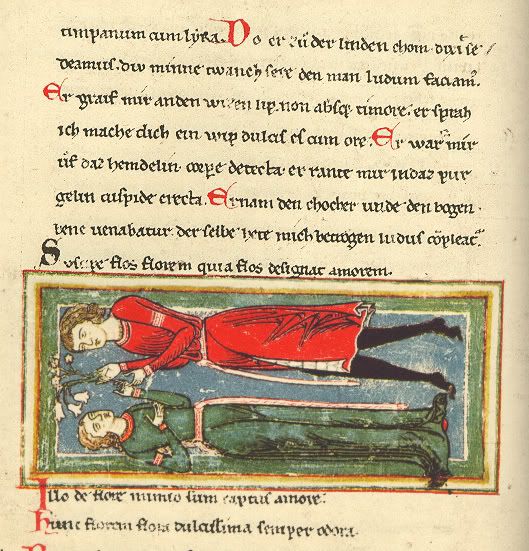
Below is an excerpt from the codex, featuring the writing and the notation. In the space above the text you can see the earliest forms of musical notation, neumes, which allow a very rough idea of what this song must have sounded like.
These are unheightened neumes, neumes without staff-lines, and therefore allow only a very rough idea - oddly enough, as notation with staff lines was technically known in the days when the Codex Burensis was supposedly composed, which is around 1230, although possibly not so much for secular music. The songs for which they do have melodies thus were all assembled through concordances with other manuscripts. From what I know, there is no explanation for why adiastemic neumes were used in the collection, especially as the collectors were clearly learned enough to know about the other notation systems. (While trawling the internets for more information on this, I came across this utterly awesome project devoted to digitalising neumes.)
The songs in the collection are attributed to the Goliards, German, English, Italian and French vagrant monks from the profane order of "St Golias", who were, in contrast to other monks, not averse to wine, woman, and song. They were clerical students who travelled from university to university or just generally travelled. The songs do offer a lot of evidence of their education - there are both paragraphs in Latin as well as quotes from philosophers and scholars. The Goliards were following the probably fictional "St. Golias" and were very critical of the political powers and the church, and wrote satirical poems and songs to express their discontent, but also bawdy songs and tales.
If this attribution is correct, that would make the codex an example of around 778 years old student culture, which is somehow awesome.

Crocky brought home a version from a music project and it's so awesome I fell in love with it, in spite of the text. It probably reflects the culture and the idea of humour from back in the day very well. I did not find the song from that project anywhere online, but an example of a similar idea of what the melody must have sounded like can be found on this CD, it's no.7.
This is the text:
185
1.
Ich was ein chint so wolgetan,
virgo dum florebam,
do brist mich div werlt al,
omnibus placebam.
Refl.
Hoy et oe!
maledicantur tilie
iuxta viam posite!
2.
Ia wolde ih an die wisen gan,
flores adunare,
do wolde mich ein ungetan
ibi deflorare.
Refl.
Hoy et oe!
maledicantur tilie
iuxta viam posite!
3.
Er nam mich bi der wizen hant,
sed non indecenter,
er wist mich div wise lanch
valde fraudulenter.
Refl.
Hoy et oe!
maledicantur tilie
iuxta viam posite!
4.
Er graif mir an daz wize gewant
valde indecenter,
er fuorte mih bi der hant
multum violenter.
Refl.
Hoy et oe!
maledicantur tilie
iuxta viam posite!
5.
Er sprach: «vrowe, gewir baz!
nemus est remotum.»
dirre wech, der habe haz!
planxi et hoc totum.
Refl.
Hoy et oe!
maledicantur tilie
iuxta viam posite!
6.
«Iz stat ein linde wolgetan
non procul a via,
da hab ich mine herphe lan,
tympanum cum lyra.»
Refl.
Hoy et oe!
maledicantur tilie
iuxta viam posite!
7.
Do er zu der linden chom,
dixit «sedeamus»,
- div minne twanch sêre den man -
«ludum faciamus!»
Refl.
Hoy et oe!
maledicantur tilie
iuxta viam posite!
8.
Er graif mir an den wizen lip,
non absque timore,
er sprah: «ich mache dich ein wip,
dulcis es cum ore!»
Refl.
Hoy et oe!
maledicantur tilie
iuxta viam posite!
9.
Er warf mir uof daz hemdelin,
corpore detecta,
er rante mir in daz purgelin
cuspide erecta.
Refl.
Hoy et oe!
maledicantur tilie
iuxta viam posite!
10.
Er nam den chocher unde den bogen,
bene venabatur!
der selbe hete mich betrogen.
«ludus compleatur!»
Refl.
Hoy et oe!
maledicantur tilie
iuxta viam posite!
(from the online version of the Carmina Burana, hosted by the Bibliotheca Augusta.
185
1.
Ich was ein chint so wolgetan,
virgo dum florebam,
do brist mich div werlt al,
omnibus placebam.
Refl.
Hoy et oe!
maledicantur tilie
iuxta viam posite!
2.
Ia wolde ih an die wisen gan,
flores adunare,
do wolde mich ein ungetan
ibi deflorare.
Refl.
Hoy et oe!
maledicantur tilie
iuxta viam posite!
3.
Er nam mich bi der wizen hant,
sed non indecenter,
er wist mich div wise lanch
valde fraudulenter.
Refl.
Hoy et oe!
maledicantur tilie
iuxta viam posite!
4.
Er graif mir an daz wize gewant
valde indecenter,
er fuorte mih bi der hant
multum violenter.
Refl.
Hoy et oe!
maledicantur tilie
iuxta viam posite!
5.
Er sprach: «vrowe, gewir baz!
nemus est remotum.»
dirre wech, der habe haz!
planxi et hoc totum.
Refl.
Hoy et oe!
maledicantur tilie
iuxta viam posite!
6.
«Iz stat ein linde wolgetan
non procul a via,
da hab ich mine herphe lan,
tympanum cum lyra.»
Refl.
Hoy et oe!
maledicantur tilie
iuxta viam posite!
7.
Do er zu der linden chom,
dixit «sedeamus»,
- div minne twanch sêre den man -
«ludum faciamus!»
Refl.
Hoy et oe!
maledicantur tilie
iuxta viam posite!
8.
Er graif mir an den wizen lip,
non absque timore,
er sprah: «ich mache dich ein wip,
dulcis es cum ore!»
Refl.
Hoy et oe!
maledicantur tilie
iuxta viam posite!
9.
Er warf mir uof daz hemdelin,
corpore detecta,
er rante mir in daz purgelin
cuspide erecta.
Refl.
Hoy et oe!
maledicantur tilie
iuxta viam posite!
10.
Er nam den chocher unde den bogen,
bene venabatur!
der selbe hete mich betrogen.
«ludus compleatur!»
Refl.
Hoy et oe!
maledicantur tilie
iuxta viam posite!
(from the online version of the Carmina Burana, hosted by the Bibliotheca Augusta.
English version by David Parlett - it's not very accurate, as it focuses on maintaining a rhyme and not exactly on literalness. Especially his Latin translations are often quite far off.
Trans. David Parlett, found here.
I was a child and fair to see
Oh, what a lovely girl I was
virgo dum florebam [when I was young and pure]!
Everyone thought the world of me,
omnibus placebam [I charmed them, to be sure].
Refrain: Hoe et oe!
maledicantus tilie
iuxta viam posite!
[Alas and lack-a-day!
Thrice cursèd be the linden tree
that grows along the way!]
The fields I wandered unaware
flores adamare [to pluck me a bouquet];
a wicked stranger met me there,
ibi deflorare [to pluck ME, so to say].
Alas...
He took me by my snow-white hand,
sed non indecenter [not without hesitation]
and led me o'er the meadowland
valde fraudulenter [with some prevarication].
Alas...
He grasped me by my garment white,
valde indecenter [ very indecently
and pulled at me with all his might,
multum violenter [excruciatingly].
Alas...
He spoke then: "We must hurry on,
nemus est remotum" [these woods look good enough].
I wish that I had never gone,
planxi et hoc totum [I cried, and all that stuff].
Alas...
"Thee stands a linden, pretty maid,
non procul a via [not very far from hence],
my harp is lying in its shade,
tympanum cum lyra" [and suchlike instruments].
Alas...
When the tree was overhead,
dixit: "Sedeamus," [he said, "Here's where we'll sit"],
spurred by passion then he said:
"ludum faciamus!" [Let's play around a bit.]
Alas...
He seized me then without ado,
non absque timore [not without nervousness].
"I'll make a woman now of you,
dulcis es cum ore!" [you've got a pretty face!]
Alas...
He pulled my clothing off in haste,
corpore detecta [he bared me pink as ham]
and straight into my castle raced,
cuspide erecta [with a rampant battering-ram].
Alas...
He took his quiver and his bow,
bene venabatur! [how well his hunt did go!]
And this was he who tricked me so,
"Ludus compleatur!" ["Thanks, darling. Cheerio!"]
Trans. David Parlett, found here.
And a German one I found here:
Ich war ein unschuldiges Kind
damals, als ich entjungfert wurde,
alle Welt nannte mich tugendsam,
allen gefiel ich.
Hoy et oe
verflucht seien die Linden
gerade am Weg gelegen.
Ich wollte damals an die Wiesen gehn,
Blumen pflücken,
da wollte mich ein Strolch
dort entjungfern.
Hoy et oe
verflucht seien die Linden
gerade am Weg gelegen.
Er nahm mich bei der weißen Hand,
aber nicht unschicklich,
er zog mich den weißen Pfad -
sehr trickreich.
Hoy et oe
verflucht seien die Linden
gerade am Weg gelegen.
Er griff mir an das weiße Gewand
sehr unschicklich
er führte mich bei der Hand
mit viel Gewalt.
Hoy et oe
verflucht seien die Linden
gerade am Weg gelegen.
Er sprach: „Mädchen, laß uns gehen.
Der Wald ist weit genug"
Dieser Weg soll verflucht sein!
Ich jammerte den ganzen Weg.
Hoy et oe
verflucht seien die Linden
gerade am Weg gelegen.
„Es steht eine schöne Linde
nicht weit vom Weg
da habe ich meine Harfe gelassen,
die Trommel mit der Leier.
Hoy et oe
verflucht seien die Linden
gerade am Weg gelegen.
Als er zu der Linden kam,
sagte er: „Setzen wir uns,"
- die Lust veränderte den Mann -
„Laß uns ein Spiel machen!"
Hoy et oe
verflucht seien die Linden
gerade am Weg gelegen.
Er griff mir an den weißen Leib,
nicht ohne Furcht bei mir,
er sprach:„Ich mache dich zum Weib,
du bist zum Beten zu süß!"
Hoy et oe
verflucht seien die Linden
gerade am Weg gelegen.
Er warf mir das Hemdlein ab,
der Körper lag bloß,
er drang mir in meinen Schoß
mit aufgerichtetem Speer.
Hoy et oe
verflucht seien die Linden
gerade am Weg gelegen.
Er nahm den Köcher und den Bogen,
man(n) hatte gut gejagt ,
er hatte mich betrogen,
das Spiel war beendet.
Hoy et oe
verflucht seien die Linden
gerade am Weg gelegen.
Below is an excerpt from the codex, featuring the writing and the notation. In the space above the text you can see the earliest forms of musical notation, neumes, which allow a very rough idea of what this song must have sounded like.
These are unheightened neumes, neumes without staff-lines, and therefore allow only a very rough idea - oddly enough, as notation with staff lines was technically known in the days when the Codex Burensis was supposedly composed, which is around 1230, although possibly not so much for secular music. The songs for which they do have melodies thus were all assembled through concordances with other manuscripts. From what I know, there is no explanation for why adiastemic neumes were used in the collection, especially as the collectors were clearly learned enough to know about the other notation systems. (While trawling the internets for more information on this, I came across this utterly awesome project devoted to digitalising neumes.)
The songs in the collection are attributed to the Goliards, German, English, Italian and French vagrant monks from the profane order of "St Golias", who were, in contrast to other monks, not averse to wine, woman, and song. They were clerical students who travelled from university to university or just generally travelled. The songs do offer a lot of evidence of their education - there are both paragraphs in Latin as well as quotes from philosophers and scholars. The Goliards were following the probably fictional "St. Golias" and were very critical of the political powers and the church, and wrote satirical poems and songs to express their discontent, but also bawdy songs and tales.
If this attribution is correct, that would make the codex an example of around 778 years old student culture, which is somehow awesome.


![[identity profile]](https://www.dreamwidth.org/img/silk/identity/openid.png)
no subject
Date: Wednesday, July 9th, 2008 09:45 am (UTC)no subject
Date: Wednesday, July 9th, 2008 09:50 am (UTC)